This article was originally published on my Substack on 1 February.
Inspired by an essay by Brendan McCord, please excuse this self-indulgent exploration of thinking about thinking and what might make us different to AI.
After a busy end to January, finding the time to relax has found me a little self indulgent; I’ve been inspired to think about thinking.
Rain is thudding down outside the window. I went into my Sunday afternoon with a drip V60 black coffee and a copy of the FT Weekend magazine; feet up, warm. I find myself devouring the FT Weekend cover to cover whenever I buy the paper, which is sporadically. Whatever the topic, from humanitarian crises in Sudan to Jay Rayner’s nostalgic review of a Leeds pub, the journalism in the FT Weekend is always enticing. In particular, last week’s had an essay entitled: ‘The answer machines’ by Cosmos Institute founder and chair Brendan McCord. I started the essay in a little huff; not another AI thought piece, please… but McCord has an inquisitive style that reads so naturally it sneaks up on you and hooks you in. I took the crux of his essay to be a call to humanity for real thought, a ‘modern philosophy’, away from our established academia of generating answers to questions – other things, notably AI, will (and in some cases do) already process answers better. Humanity’s real value is in thought itself, and thought is defined by questioning and listening, not answering.
The existential question of ‘What is it to be human?’ and our collective ego that we must, ultimately, mean something is both a luxury and curse of having conscious thought. That’s the very thing most of us are convinced AI can’t imitate. Thinking about questions, or being deliberately inquisitive, isn’t that normal to us. If we ask a question today it usually stems from the impulse of a need, and we usually flip out our phones and Google it. The Q&A dopamine is supplied and we continue on. When do we really think thoughts? I find it is only when we slow down, or escape the treadmill of daily routines. It’s the long walk in the country, the boredom at the bus stop when your phone’s died, or the tossing and tumbling in a bad night’s sleep.
I have thought about AI and its revolution and wondered if wine, something that’s existed for millennia, would be safe in this new world we’re building. After all, computers can’t drink the wine for you, can they? We’re more likely to be threatened by government legislation or a climate crisis; not ignoring that the latter could be both more or less likely depending on how we utilise the new age of AI.
But perhaps really the thing that resonates with those of us truly enamoured by wine is that it doesn’t bring any simple answers. When wine becomes more than a commodity or an enjoyment and instead, for those few of us, becomes an obsession, perhaps that is when we realise why it is so enduring? Drink a glass of wine with curiosity and it’ll bring you more questions than answers. What does it taste like? Why are those flavours there? How did it happen? What did the growers and the winemakers do? What is the culture of the place, its history? Where and how deeply did the vines root?
More importantly, even if we knew the answers to all the above questions, would it make any difference to our enjoyment of the wine? Perhaps it’s the mystery of the wine itself, or the love of those we’re sharing it with. Maybe it’s the restful sigh after a familiar taste, or the way the acidity wakes up your palate to the flavours the alcohol has enhanced? Magically, I would bet that every one’s experience and moment is unique to themselves. We all have different whys, and so the answer is meaningless to anyone other than you. It’s the way the wine has inspired you to question, to think, that makes wine human.
I wonder if instead of finding solitude in the saying ‘ignorance is bliss’ it is better to be naive and unknowing but deliberately curious. In McCord’s essay he quotes Socrates asking the mathematician Theaetetus, ‘What is knowledge?’ Three times Theaetetus answers, and each time Socrates inquires further and Theaetetus pivots from his answer. You can do the same with AI: a better prompt will cause it to pivot and answer differently. AI needs thoughtful prompts to give useful answers. Humanity, in our new world, is going to have to rediscover how to question, how to really think, if it wants to stay relevant.
Perhaps that’s what makes a good glass of wine and a long walk all the more meaningful.
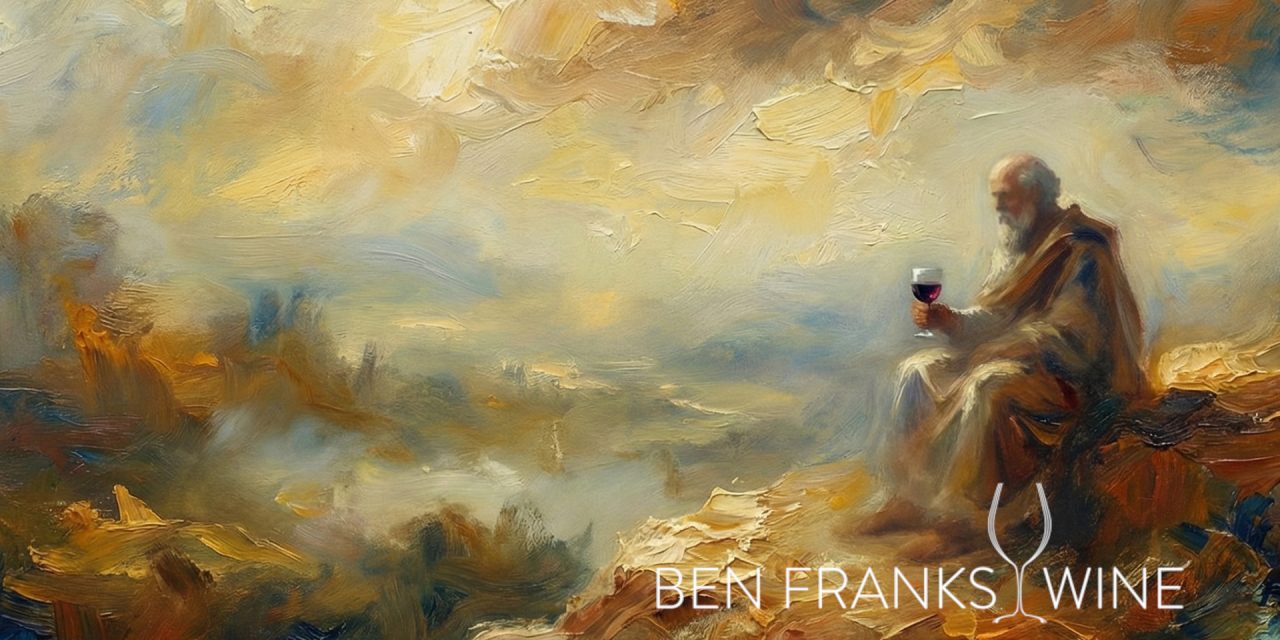
The image for this blog was created by Gemini with the prompt ‘Create an image in the style of J M W Turner that imagines Socrates enjoying a glass of wine. Use thick oil brush strokes’. When I see art by Turner, one of my favourite artists, I ask questions and imagine depth and dream-like adventures and possibilities. In Gemini’s ‘thinking’ Nano Banana Pro rendition, I am left only with what I asked for.